we should put on a show
from an interview with Phil Gomm, conducted on 15 July 2026
In May 2001, the final-year BA Photography students at Kent Institute of Art and Design staged their degree show, In Motion, inside Hackney Downs School, a derelict former secondary school in east London, transforming its classrooms into exhibition spaces. I was on the staff; I taught video for the photography course, and ended up overseeing the installation and filming the whole process.
the abandoned school
When I think about that school and when I think about that project, it comes back as a series of very vivid vignettes. The school was freezing cold. It had been locked up for a long time, so when we were in the corridors and classrooms and all the interim spaces and the swimming pool, the air was refrigerated. I remember living from one crap cup of instant coffee to the next, for the warmth more than anything. I remember the doors opening and walking into the chill and thinking, how are we going to bring this space back to life?
The fact that it was an empty school gave the interiors this uncanny quality. Empty classrooms. There was still all this detritus, chairs, chalked words on the blackboards, all of this paraphernalia that spoke to the absence of children and failed education. It was highly evocative. But there was so much work to do that it was overwhelming.
the installation
Kevin Liggett, the photography course leader, recognised that such an ambitious project required a pragmatic approach, and he believed I was the right person to deliver it. My previous degrees were in making — 3D design, working with my hands. Even though for my master's I ended up making film, I'd come from a grubbier ‘making’ mindset. So maybe Kevin decided there was a combination of skill sets that were useful. The truth is that the whole cohort was pragmatic. I wasn't doing it alone — far from it. Everyone worked hard to get the school ready for the opening of the In Motion exhibition, and that collective effort was what made the scale of it possible.
I have a very clear memory of rewiring the fluorescent lights in one of the classrooms. There I was, sitting on top of a high scaffolding tower with a screwdriver, not knowing what I was doing, on the phone my brother: "I've got to get all these bloody fluorescent tubes to work. What do I need to know so I don’t burn the whole place down?" And my brother talked me through it while I was rewiring. That was a classic example of what it was like on-site — it was all a bit hand-to-mouth. Every single classroom, every single space provided a new problem. The whole cohort was in it — building, painting, cleaning, wiring things up. We just invented and improvised.. The school was like a puzzle box in that way. We had to fix every room, every situation, in a slightly different way. You can't really plan for the moment when you've hired a hydraulic cherry picker and you’re riding in its basket to fix a window in the swimming pool to stop the pigeons getting in; we're up there with a blue tarpaulin and a staple gun. That morning, we probably didn't know we were going to do that. It was always like that; we've got a staple gun, we've got a cherry picker, we're fixing the window today… If we'd worried about everything more, we would have wasted time we didn’t have.
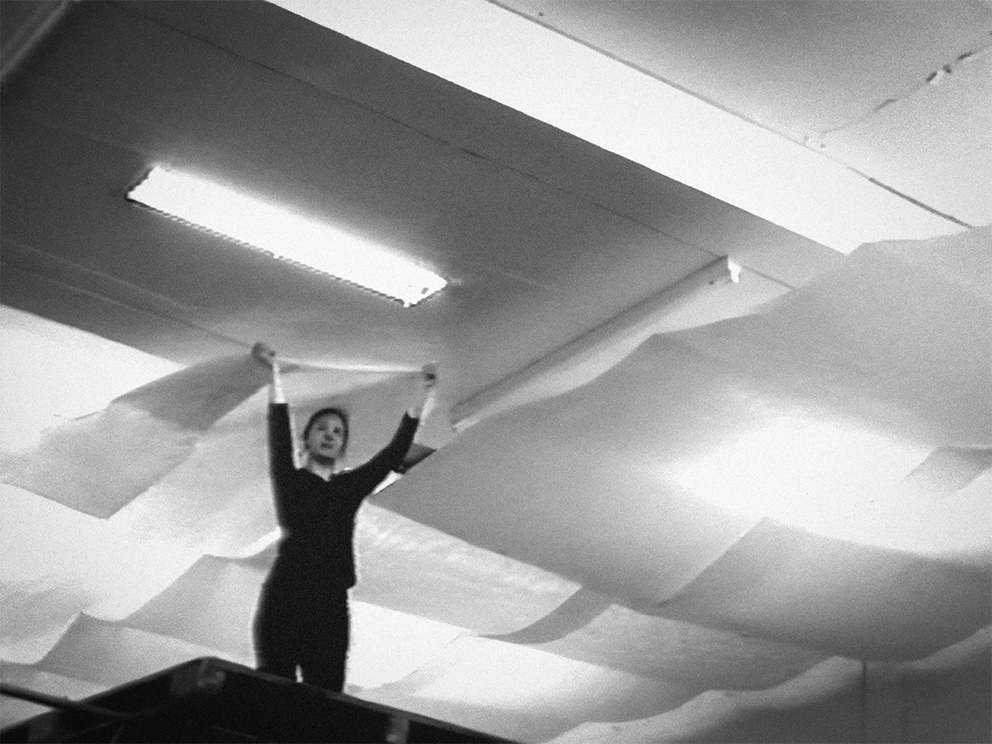
In the ‘making of’ film, you see one photography student riding along on top of that same scaffolding tower. She is installing these great long ribbons of white transparent fabric to ‘softbox’ the classroom ceilings. We'd laced up each classroom with an invisible fretwork of fishing wire, screwed and held on battens all the way across on both sides of the room, so the fabric could lie on what were essentially guitar strings. That solution derived entirely from my work on my MA, when I created this big floating installation of screen-printed silks and projectors in one of Kevin’s photography studios installing things and hanging things. I was drawing on that prior experience of working in big spaces with limited funds, sourcing low-budget bits and bobs from hardware shops and repurposing materials that weren't designed for the job.
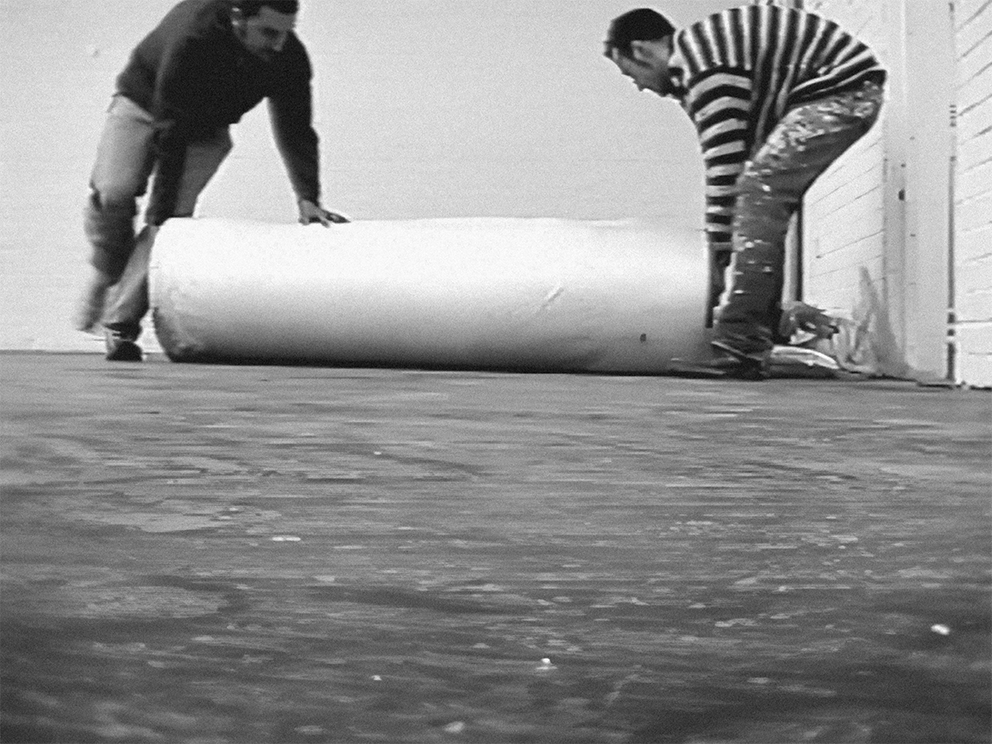
That white fabric on the fishing wire was some kind of industrial fabric — a huge roll of it, cheap because it wasn't designed for galleries. One of my strongest memories — indelible because you see the same moment in the making of film — is myself and James Blake walking out into one of the outside spaces. James was one of the exhibiting students, but he'd also taken on the role of site manager — he gave so much of his time and energy to getting that school ready. We come up with this idea to use another industrial material, a white membrane used before tarmacking roads, I think. We had a massive roll of it and used it to create these white display areas outside, so photographs could be mounted outdoors. One day we got the whole outside area covered, and the sun came through, and we suddenly realised we were capturing shadows and the play of light. Something wonderful was happening – something richly photographic. They say perfect is the enemy of the good, but sometimes you end up with perfect anyway, even though the materials are unprepossessing. That whole show was an example of using materials with intention, then seeing the effect in that particular space, and realising: we're going to make this happen. More than this; it’s going to be great.



men in motion
Practically, we had to raise money to pay for refurbishing Hackney Downs site. The Full Monty was a cultural force at that time — this hugely successful film about a group of underdogs making something happen – by good-naturedly taking off all their clothes!
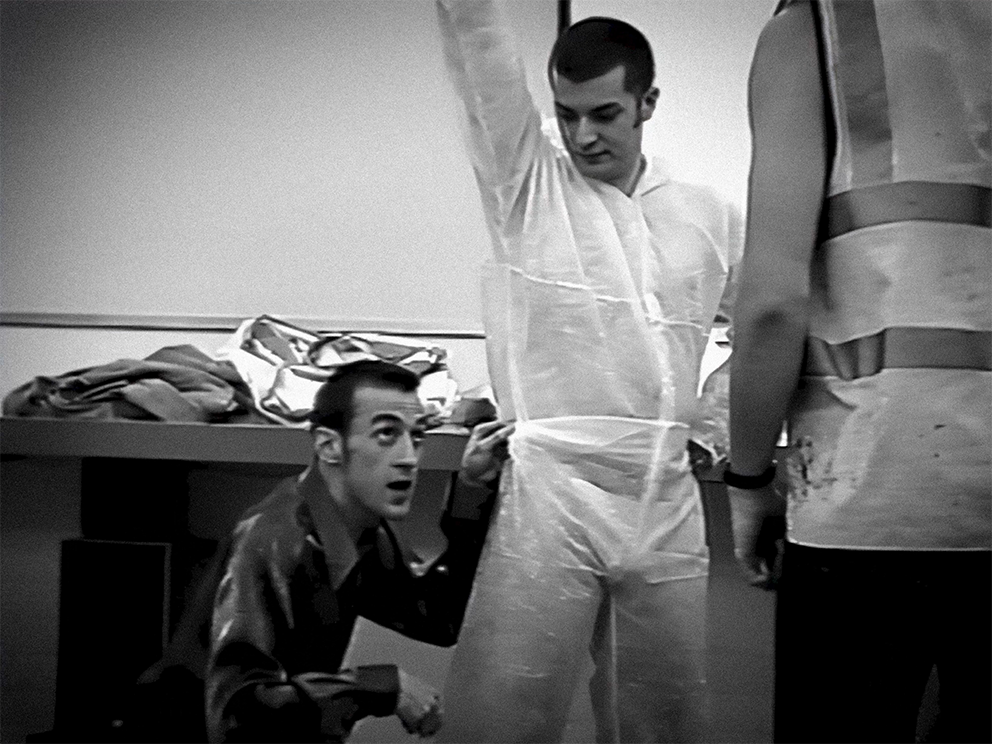
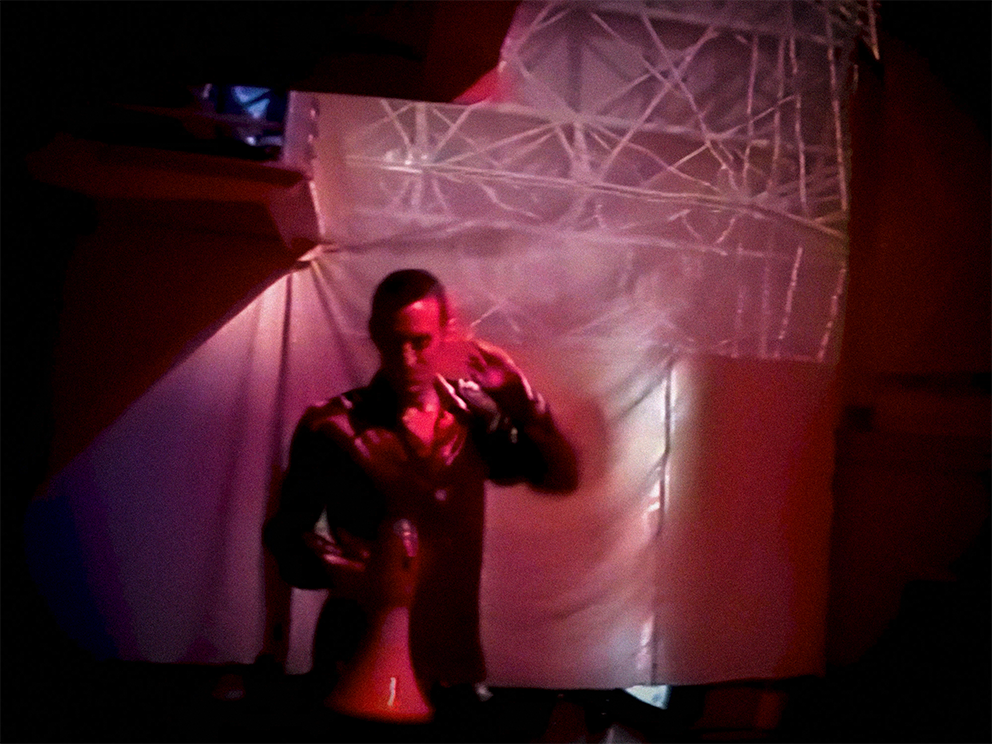
There's this cliché in musicals, where a motley crew of people need to solve a problem and raise money, and somebody says, "We should put on a show." In those movies, there follows this montage of everyone coming together to achieve their goal. There was something about the In Motion project which felt like that—the art of the possible. It didn't once feel strange or inappropriate that we got the male photography students to put on a burlesque performance in the style of The Full Monty in the KIAD student bar to raise funds. When you watch the ‘Men In Motion’ film, you see right away that it was the least sleazy erotic spectacle you could imagine; it was this beaming group of art school lads being very warmly received by their community
We raised a lot of money that night (the students had to perform twice, which saw them having to hastily retrieve their clothes from wherever they’d thrown them during the first performance. So when you went into the school and saw this rich and sophisticated exhibition, at least some of it was funded by this slightly ramshackle "let's get the gang together" idea.
People are capable of incredible things, but we can define ourselves quite strictly — "I'm a photographer, I'm this professional person not that person” – so we worry if we step outside of our role, as if something bad might happen to out core identity. In this instance, there was this lovely sense that people are more like a Terry's Chocolate Orange — sorry about that ridiculous image! — made up of segments or chunks. The Men In Motion performance was a bit of fun and it made a lot of money, but it was indicative of what was happening more broadly in that particular year group: an eclectic community of like-minded people enacting photography, film, moving image, installation, performance…
It was peak art school, and when I think about it now, I just think how lucky I was to be a part of it. It was definitely ‘a moment in time’.



the films
I had a video camera with me throughout the In Motion project – and likewise made sure the video was passed to the students to capture what was happening when I wasn’t around. When I wasn't on a cherry picker or sweeping up pigeon shit, I was teaching video editing to the photography students; how it's possible to build narratives out of fragments. I've always loved that. So having the camera was a busman's holiday. It was in my job description, but I knew even then that this was one of those projects that, if it wasn't remembered or kept, we'd forget how much work it had taken.
When I look back at those eight films now, I'm just glad they exist at all. They have both captured and perhaps limited my memory. I watch them and think, “Of course it was like that”, but I can't remember the downtimes as clearly. the defeats, because montage is good at making everything feel like we had a plan, and success was inevitable. We all had days where that wasn't true. I suspect we were all good and sick of the sight of that school and, on some days, couldn't believe we had to go up there again.
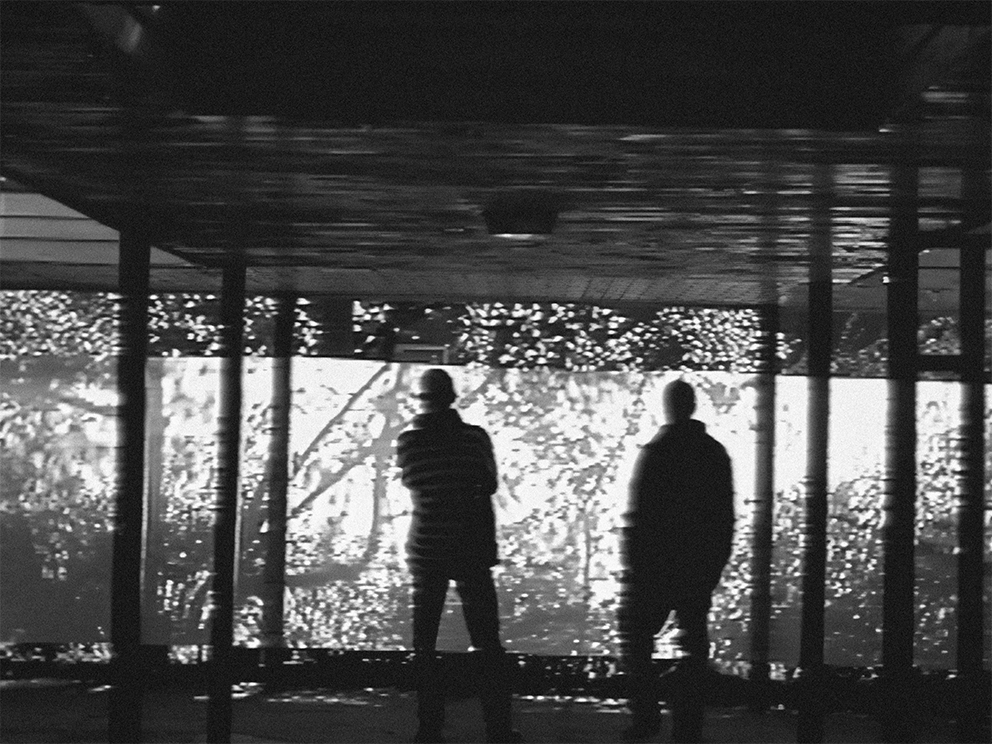
When I restored the films for the Still In Motion archive—went in and fixed them, refound the music, relooked at things—I found myself staring at a young version of myself, and at versions of students I hadn't thought about in 20 years. It was Proustian. The more work I did on those films, the more present that period became. When I watch the film in which the students are standing by their work, with the sun streaming in through the classroom windows, I’m back, standing there myself.
The films help us ensure that this ‘urge to archive’ isn't just nostalgia. They're evidence that this thing actually happened. Under different circumstances, with different people, with different leadership, with a different culture, there would have been no films because In Motion would never have happened. So, the films are proof of the conditions that made it possible, how the risks everyone took were made to feel like human acts of creative autonomy, how a community of people felt empowered to make something happen.
the culture
In Motion was risky. We all took risks, I think - not in the sense that we were in danger, but by any criteria, that project was risky, what with the size of that school, what was ahead of us, the decisions we had to take. I had huge creative autonomy as a member of the photography staff, and huge responsibility to deliver, but I was not on my own. I felt emboldened and normalised by the examples being set by everyone else, the students included. I think that's how you know you're in a culture — or a cult, I'm not sure! It didn't feel unreasonable that we were all working that hard, making those decisions, carrying that responsibility. It did not feel like a burden. It felt both normal and exceptional. It felt important.
Since then I've encountered other teaching cultures and realised this was not a normal set-up. I've worked in places and with people where what we did back then would have been seen as beyond the pale. Outrageous, dangerous, irresponsible. But it never felt that way and I don’t think it was that way either. We were safe and strong and bold because we were regarded as so by Kevin and Caroline Scott, and by each other. You were valued and trusted to sort things — "You're here because you have skills to offer, use them" — Isn’t that the best incentive to get the best out of anyone?. It’s the opposite of gatekeeping, as in “you've already got it, so do it, use it” in contrast to “I've got it, you need to listen, then you might get to do it yourself”. That exists everywhere in education. It's a postponement culture. “When you're older, when you're better, when you're ready, when you're like me, when you've got the answer, when it's perfect.” If we'd had that postponement culture twenty-five years ago, In Motion would have been an impossible act of imagination. It was the opposite of postponement. It was such a well-titled show, because we were in motion from the outset. If we'd stopped, it wouldn't have happened. We would have talked ourselves out of it.
the hidden curriculum
My reasons for leaving the higher education sector, for leaving the same institution where all of this happened years earlier, are nested and complicated. But one of the reasons I left was because the job roles available to me were increasingly bureaucratic. It was the end of doing. The end of agency. I'm built, as an educator, in the image of pragmatism, my sleeves pushed all the way up.
Now I run my own learning design agency and master's degree in creative teaching and learning design. I’m talking constantly about the importance of doing. We talk about the hidden curriculum a lot; sure, you might be trained as a photographer, but underneath all of that subject specialism, do you also have everything you need to mobilise your identity as a photographer? When I look back at In Motion, you couldn’t ask for a clearer expression of the hidden curriculum; what was happening with that group of people, myself included, pivoting daily; problem solving—choreography!—performing; all these non-photography skillsets that enabled them to be seen as photographers
My frustration with how most learning is administered is that it's so fucking slow. It postpones. Those In Motion students knew that they were doing something at the point they were doing it. They didn't need to be told. They didn't need a learning outcome. They didn't need an assessment. They knew something was happening because they were happening to it. The power of doing is the proper, beating heart of learning.
the archive
The important thing about deciding to build this archive now is the 25-year gap. Culturally, the characterisation of creative education is in such a beleaguered state. But when I look back down that quarter-century timeline at In Motion back in 2001, I see nothing but substantive evidence of the unique power of creative education. I can't unsee it. When I think about the archive and its value, I see it as evidence—and resistance.
What was happening on the site of that abandoned school wasn't hugely expensive. It wasn't about high-tech interventions. It was about giving people the autonomy and the confidence to learn in the now, to iterate, to build, to do. There is a creative philosophy there that needs to be re-sounded. Because to me, it just seems so terribly simple — how you get the most from people, how you deliver on career development, how you build resilience and engender ‘employability’; how you AI proof the human being; all those bloody buzzwords we hear about what education needs to deliver or else! I hear those words, re-packaged as dazzling insights, and I think: yeah, we knew that 25 years ago, we modelled it, we enacted it, and yet since, we've made the conditions to reproduce those same capacities seem more mysterious and harder to achieve.
So for me, the Still in Motion archive is really something of a creative educator’s educator’s playbook.
It was 25 years ago, but it looks a lot like the future to me.