In January 2001, thirty-eight photography students from the Kent Institute of Art and Design in Rochester took over a derelict school in Hackney, east London, and worked together to reimagine it as an exhibition space.
Hackney Downs Secondary School had been closed since 1995. Branded by the government as “the worst school in Britain” and forced to shut, the school had been standing empty for six years when the students arrived. The transformation took 100 days. Working across classrooms, corridors, outdoor spaces and the swimming pool, the students sited more than 400 photographs across its long-neglected surfaces and spaces.
The private view opened on the evening of 8 May. The show ran until 21 May.
The exhibition was called In Motion.
The exhibiting students were:
Alice Mansbridge | Ann Langbakk | Anna Laukkanen | Audhild Dahlstrom | Dag A. Ivarsoy | Daniel Sosnowsky | Elina Simonen | Emma Hier | Erik Buraas | Florent Repellin-Demarchez | Frank Widemann | Gareth Watts | Gavin Francis | James Blake | Jem Mitchell | Jennifer O'Toole | Jimi Kasteenpohja | Jon Webb | Katha Oesten | Kristin Fagerlid | Lennart Johansen | Marianne Paraskeva | Marianne Soknes Oiamo | Matthew Cameron-Wilton | Monica Telle | Muzi Quawson | Natalie Kriwy | Noah PK Chen | Omar Knaz | Patrick Nairne | Pekka Niittyvirta | Pierre Le Gonidec | Shue Matsuda | Simon James Pascoe | Skjalg Ekeland | Stacey Whitaker | William Thom
The exhibition was supported by the course staff:
Brian Bell | Ori Gersht | Phil Gomm | Keith Hartle | Kevin Liggett | Michael Poraj-Wilczynski | Caroline Scott
May 2026
In Motion (2001) was not a conventional photography degree show, but a large-scale, student-led exhibition that transformed a derelict secondary school in Hackney into a multi-site installation of over 400 photographic works. Created by 38 students and staff from a BA Photography course, it was both a public cultural event and the culmination of a three-year educational philosophy centred on authorship, narrative, and real-world engagement.
Unlike traditional end-of-year exhibitions, which are often inward-facing and limited to academic audiences, In Motion was conceived as an outward-facing public intervention. It combined ambitious curatorial strategies with a clear conceptual foundation: photography as a medium for communicating social, political, and ideological ideas.
The exhibition’s setting — a decaying, closed school — and its site-specific installations, including dark rooms, corridors, outdoor areas, and a drained swimming pool, created varied and immersive encounters with the work, drawing viewers into the physical and conceptual energies of the exhibition. It emphasised that meaning in photography is shaped not only by images, but also by context and presentation.
By framing photography as publishing — the intentional communication of ideas to an audience — In Motion demonstrates a model of education in which making, thinking, and presenting are inseparable. The exhibition was not just a display of work, but the embodiment of a learning process grounded in authorship, collaboration, and public engagement.
This approach resonates with the philosophical outlook of Jacob Bronowski, particularly his belief that knowledge is not static but constructed through inquiry, imagination, and human responsibility. Bronowski emphasised that creativity and understanding emerge through active, imaginative engagement with the world, and that education should cultivate individuals capable of questioning, interpreting, and shaping reality. In this sense, In Motion reflects a Bronowskian model of learning: one that values process over prescription, embraces uncertainty, and positions students as active contributors to culture rather than passive recipients of instruction.
The launch of the Still In Motion website on 8 May 2026 — 25 years to the day after the original exhibition opened — continues this philosophy into the present. Conceived as both a digital archive of a significant body of work and a living continuation of the educational approach that produced it, the site seeks to keep the methodology active: not simply preserving what was made, but setting its questions, energies, and principles in motion again. In a current educational landscape marked by reduced funding and a diminishing value placed on the arts, the Still In Motion operates as both record and provocation: a resource that preserves the past while inviting new generations to adopt, adapt, and reimagine its principles.
Kevin Liggett | May 2026
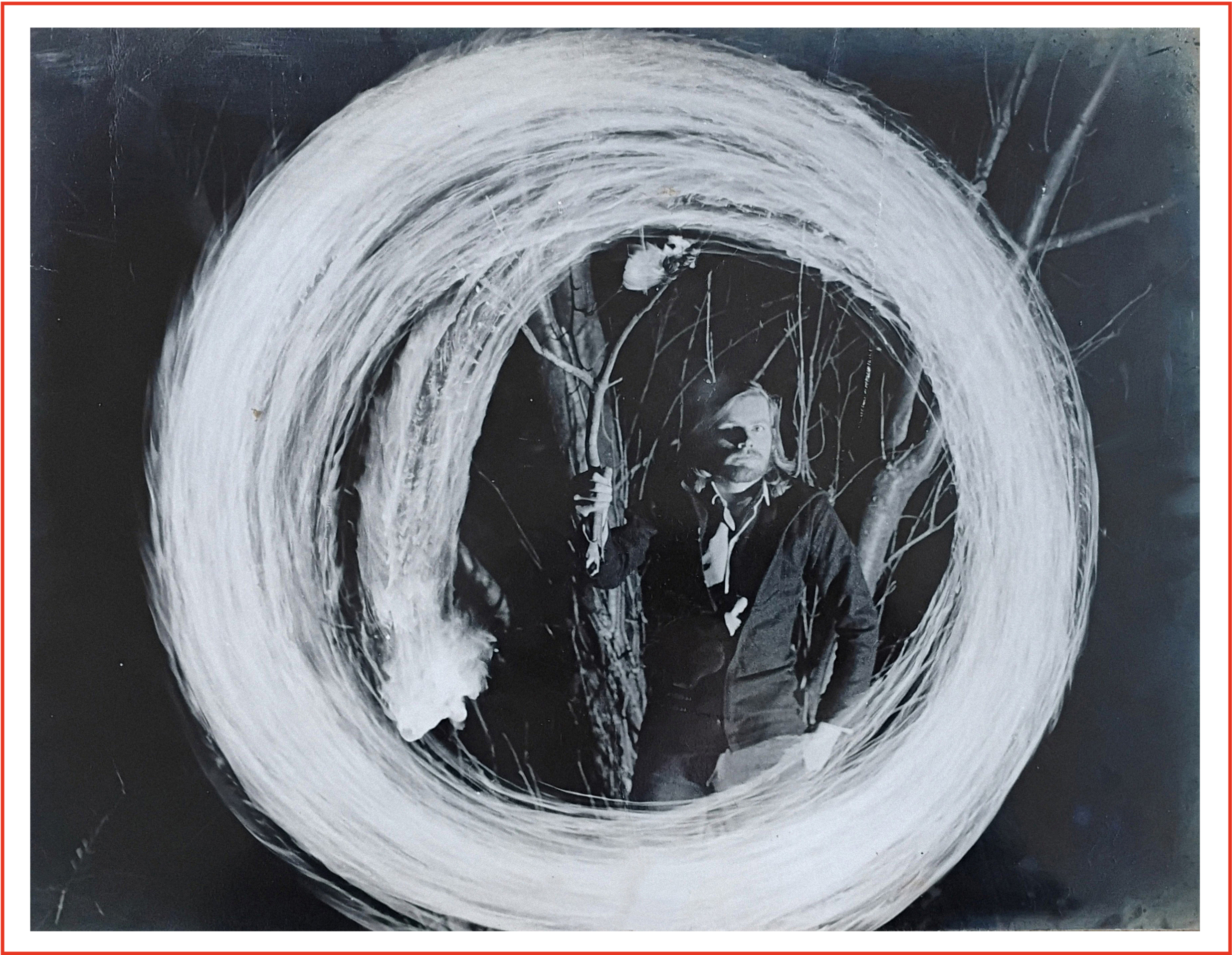
Kevin Liggett | Portal of Perception | 1970
In the autumn of 2025, I got a call from Kevin Liggett.
I have a project for you, he said.
Just like old times, I thought.
Kevin Liggett gave me my first job in creative education. Following my completion of a Masters degree at the Kent Institute of Art and Design in Rochester in 1998, he asked me to teach video editing to his second-year students on the Bachelor of Arts in Editorial and Advertising Photography. This was the beginning of a particularly rich and rewarding phase of my professional life, characterised by tutoring, filmmaking and the installation of various photography exhibitions in various cavernous venues, up against the clock, largely sleep-deprived, but happy in the company of talented students, and emboldened by Kevin Liggett and Caroline Scott, who were both indomitable in their clear-eyed commitment to making things happen.
By far the most ambitious of these adventures in place, space and imagery was the 2001 exhibition at Hackney Downs School. Chemistry had once been taught in some of those forlorn, quiet classrooms, and chemistry is how I'd describe the combination of students in that year group, a rare mixture of ambition and collectivism, a product of the culture of the course from which they were soon to graduate.
The students and I worked side by side on site, day after day. I remember the frigid cold inside those long-shuttered corridors and the crusts of pigeon excrement covering the tiled floor of the swimming pool, but all the while, I kept one of the photography department's video cameras close to hand, to document what was taking place. Even then, high in the sky on cherry-pickers or ankle-deep in guano, I knew something special was in motion. But the camera was rarely in one pair of hands for long, my intention being that nothing should go undocumented. With the students themselves filming when and where I couldn't, we amassed a rich record of footage.
I made eight short films documenting the complete arc of the project: the transformation of the school; the sweetly ribald fundraiser inspired by The Full Monty, that saw a troupe of male photography students throw caution to the wind in KIAD's student bar, along with their clothes; the showreel projected onto the screen suspended above the swimming-pool-come-dancefloor; a film of the private view on the evening of May 8; a portrait of every student onsite at the school with their work; and finally the photography course's degree show, when the student work was projected onto a big screen in the grounds of Rochester Castle.
For twenty-five years, those films existed on a single VHS tape in Kevin's possession. The original master copies are believed lost, making this the only complete record of the project that survives. When Kevin called me in 2025, he had just had the tape digitised, and would I, he wondered, see what I could do to improve some of the dropouts and glitches.
And so there I was, a quarter of a century later, revisiting footage I had first edited aged 26, giving the In Motion films a figurative lick of paint, just as we had once given the walls of that school.
The decision was taken to make the now-restored films the foundation of the Still in Motion archive. They are presented here publicly for the first time, not seen together since that sultry summer evening in the grounds of the castle, on the night In Motion returned to Rochester, which marked the ending of the students' time at KIAD, and the beginning of everything they did next.
Phil Gomm | May 2026
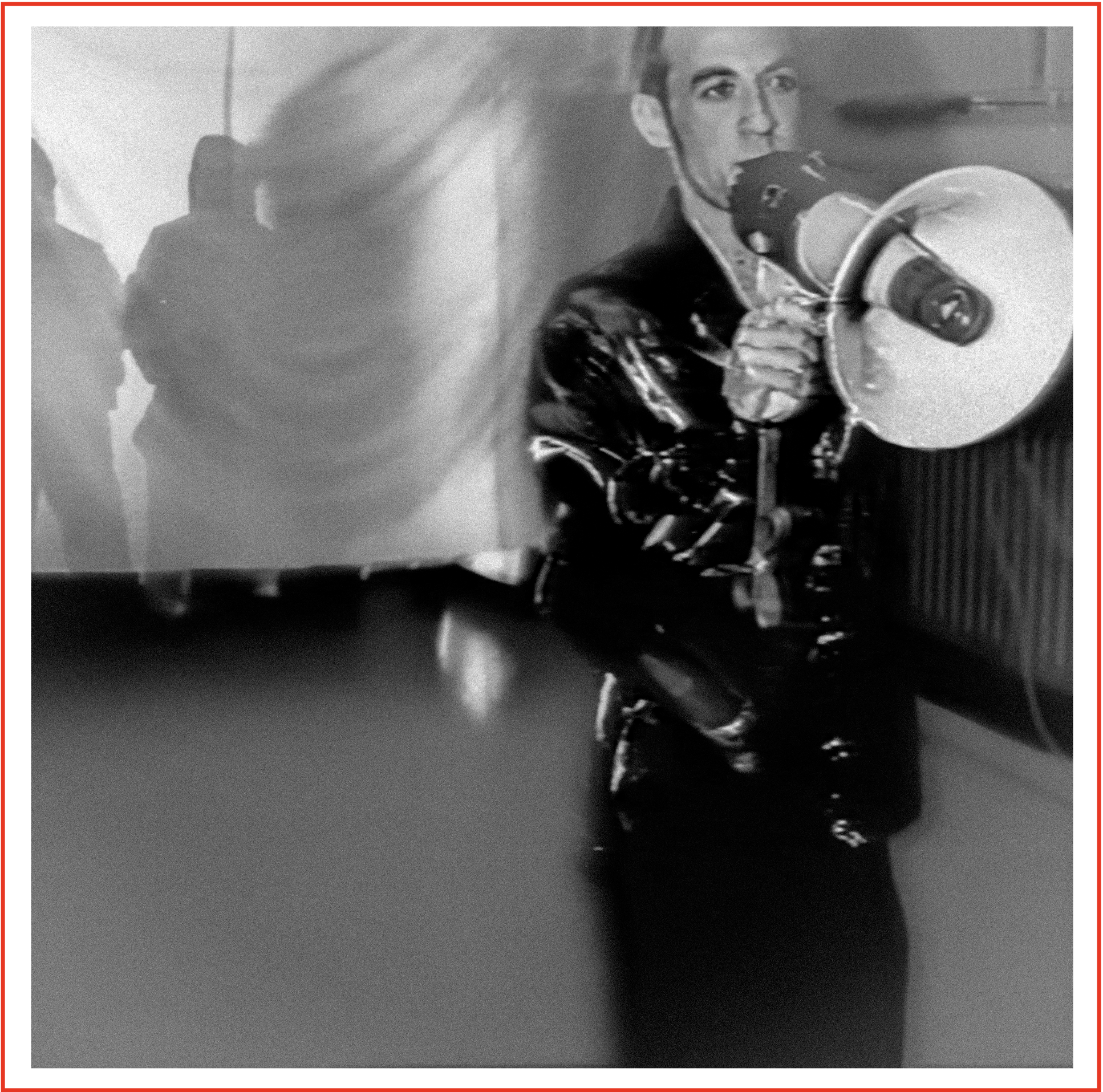
Phil Gomm | “Men In Motion”, student bar, KIAD | 2001
may 2001
There is no single concept that defines In Motion. No handy, sound-bite name-tag can label this group’s philosophy.
Neither can their work be conveniently compartmentalised into the familiar and largely meaningless categories of advertising, fashion or social documentary. There are 38 individual voices here, all with opinions they are keen to share. Some are critical and provocative, even painful; others are questioning; some are magical, amusing and playful. It is the great diversity of the ideas expressed here, through such varied imagery and even media, that is one of the great strengths of this collection of work and the exhibition which it complements.
This is photography speaking with the confidence of the 21st century. It recognises itself for the great man-made illusion that it is, and is comfortable with itself and with the fluid world of possibilities and interpretations that is contemporary, everyday life. The magic of the photographic medium is explored here, in images that exploit the alchemy of light, time and film. The seamless merging of creative or commodity-based fictions with physical space, which is our everyday image world, provides much of the subject matter.
But In Motion is more than a photography exhibition. It’s about a commitment to make an art space from a derelict site, to recycle and regenerate a building, in this case the former Hackney Downs secondary school. The space is an active one, a place where sound and performance can merge with the film and photography on show. One where a wide-ranging audience can come to look, but also to exchange ideas and make new work. The unifying concepts that define the site, the audience and the work remain those of diversity, dialogue and a desire for transformation.
Caroline Scott | In Motion catalogue foreword | May 2001
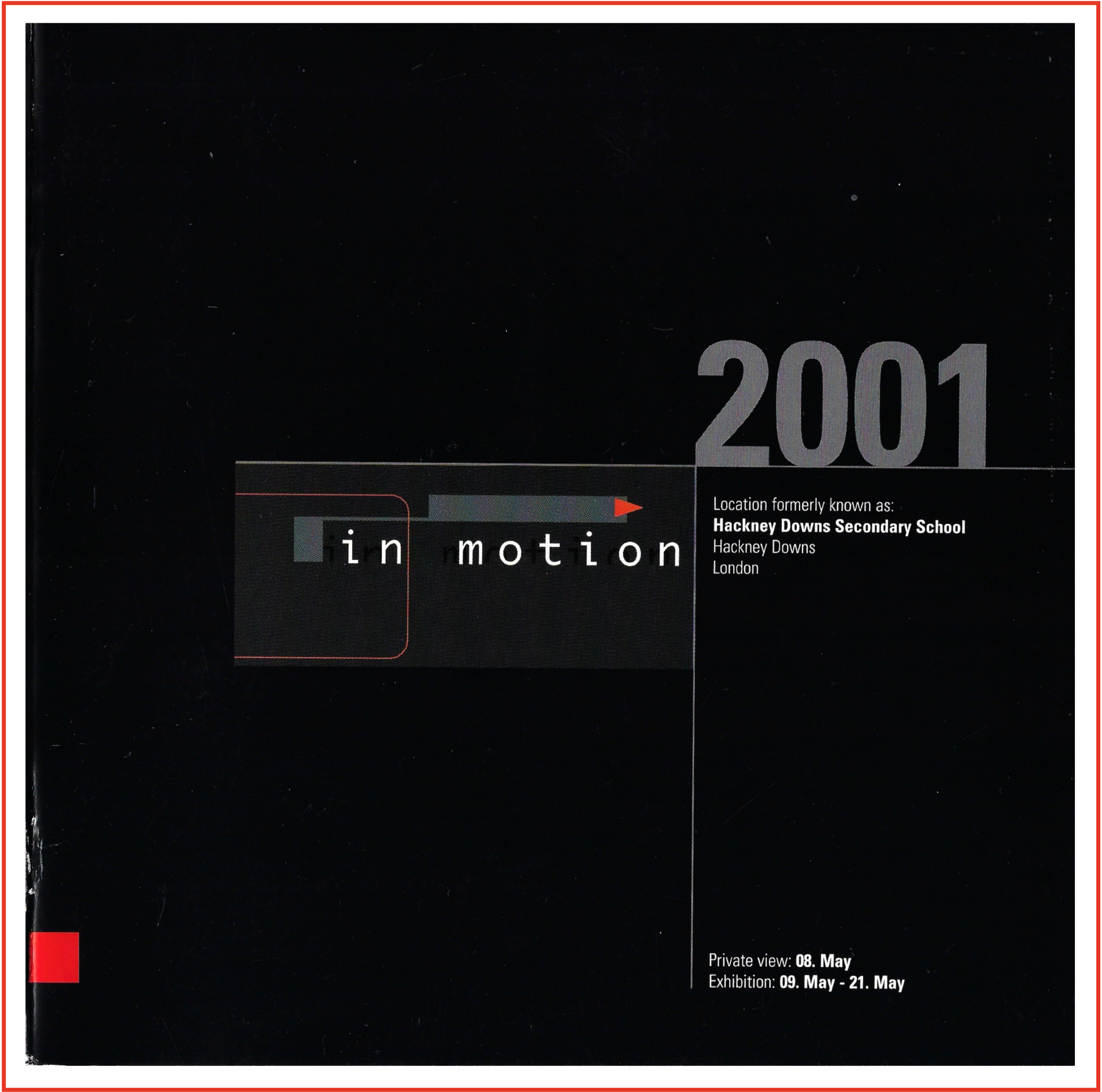
In Motion catalogue cover | 2001