the course
The photography course that produced In Motion sat at the end of a long lineage of art and design education in the Medway towns. Its earliest ancestor, the Medway School of Arts & Crafts, was founded in 1886 and ran for just over a century, shaped throughout by the Arts & Crafts movement and by the principle that practical making and serious thinking belonged together.
By 1970 the College had grown to around 600 full-time students, and its focus had broadened to treat design as part of a wider media practice. The institution evolved accordingly: a move into a purpose-built £1,000,000 facility, a rebrand as Medway College of Design, and the establishment of large studios equipped to the standards of working commercial practice. Photography became one of the department's strengths during this period, and the move to Fort Pitt at Rochester enabled the introduction of a full-time Diploma in Professional Photography — a course that placed graduates directly into the expanding fields of advertising, fashion, and editorial work.
In 1987, three Kent art colleges merged to form the Kent Institute of Art and Design. The new institution brought the existing programmes into a wider academic framework, and over the years that followed, contemporary degree courses were developed to match the changing expectations of students and the changing shape of the media industries they hoped to enter.
The photography facilities at Rochester continued to grow. In 2000, a £250,000 Digital Photographic Laboratory, supported by Hasselblad, was opened — an investment that placed the department at the front edge of the analogue-to-digital shift then reshaping the profession.
It was within this lineage that the Bachelor of Arts (Honours) in Editorial and Advertising Photography was launched at Rochester in 1997. Kevin Liggett, appointed Course Leader in 1995, had argued for a programme that would prepare students directly for the working world of commercial and editorial photography. From the outset it broke with the prevailing fine-art conventions of British photography degrees. It did so on principle: Kevin's view was that students who wanted to work in advertising or editorial photography deserved a course that took those ambitions seriously.
Under his leadership, the curriculum was structured around the working realities of the industry. Students trained on professional studio and location lighting, learned digital workflows as they emerged, and were taught how to operate as freelancers — how to market themselves, work with clients, manage commissions. Many of the staff were practising photographers, which kept teaching close to live practice; technicians provided the hands-on instruction in studio and darkroom craft. The arrangement worked: the technical and the conceptual sides of the course reinforced each other rather than competing.
The most distinctive innovation was the Industrial Release Programme. Kevin formalised what had previously been informal placement arrangements, requiring students to spend time working in professional London studios or assisting established photographers. The programme drew on Rochester's proximity to London and on the relationships Kevin had built with agencies, picture editors, and working practitioners. Students returned from placements with a clearer sense of what the profession actually demanded — and, often, with introductions that proved useful when they graduated.
The approach produced graduates who went on to work with major advertising agencies and to contribute to publications including Vogue, The Guardian, and The Sunday Times Magazine. Many built careers as commercial photographers; others moved into roles as creative directors and picture editors. The course's outward measure of success was that its students reached the desks and pages it had been designed to prepare them for.
The course developed an exhibition culture to match its industry orientation. Kevin oversaw a sequence of graduate shows held in venues outside the institution, designed to put student work in front of the people who commissioned it. The first opened at Chatham Dockyard in 1999. In 2000, two exhibitions followed: Sync, at the Atlantis Gallery on Brick Lane, and Closer, which presented student work simultaneously at four European transport hubs — Zurich Airport, Cadiz Seaport, Stuttgart Railway Station, and Canary Wharf in London — with an online audience following the exhibition as it unfolded. The following May, In Motion opened at the former Hackney Downs Secondary School in east London.
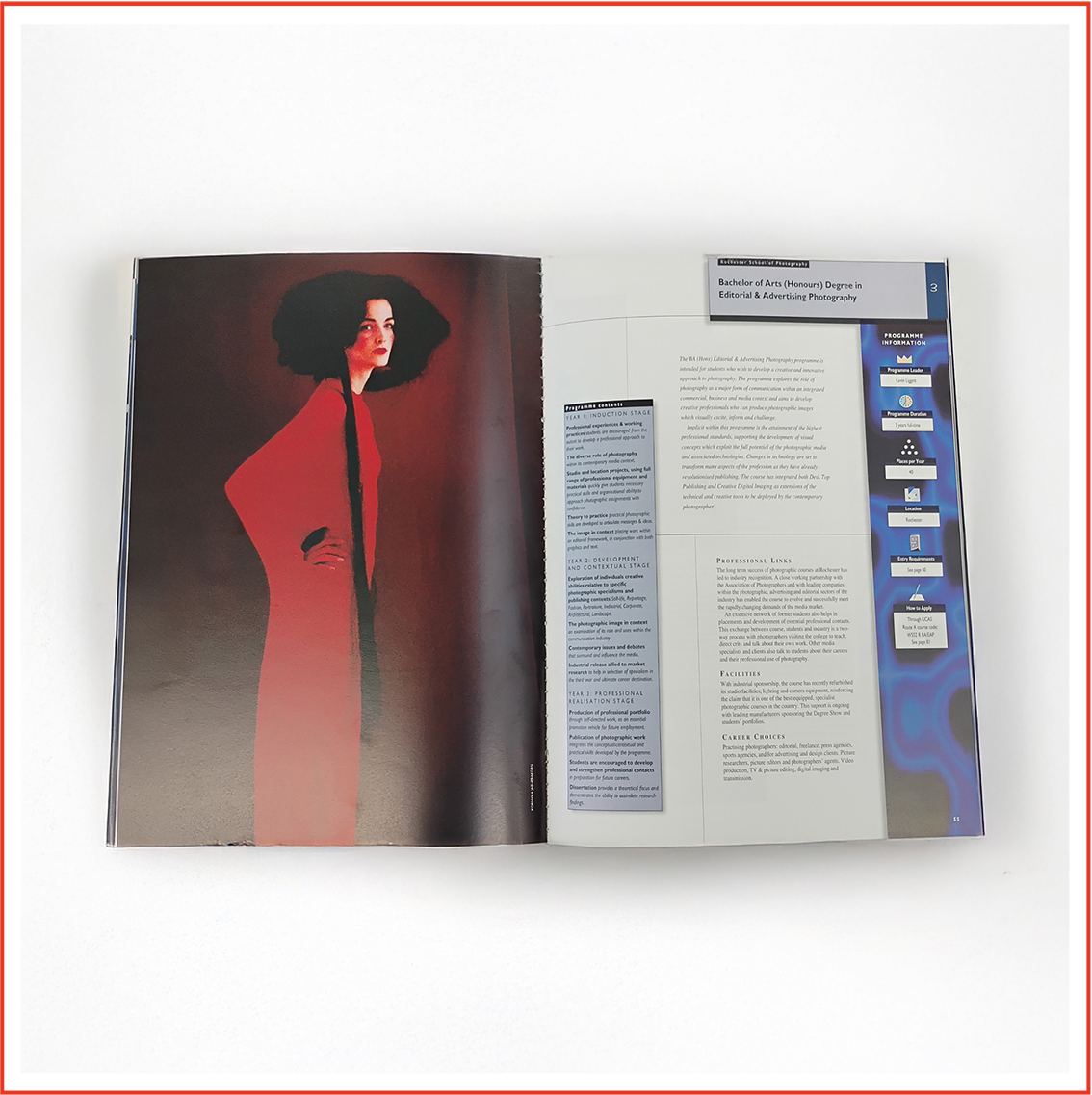
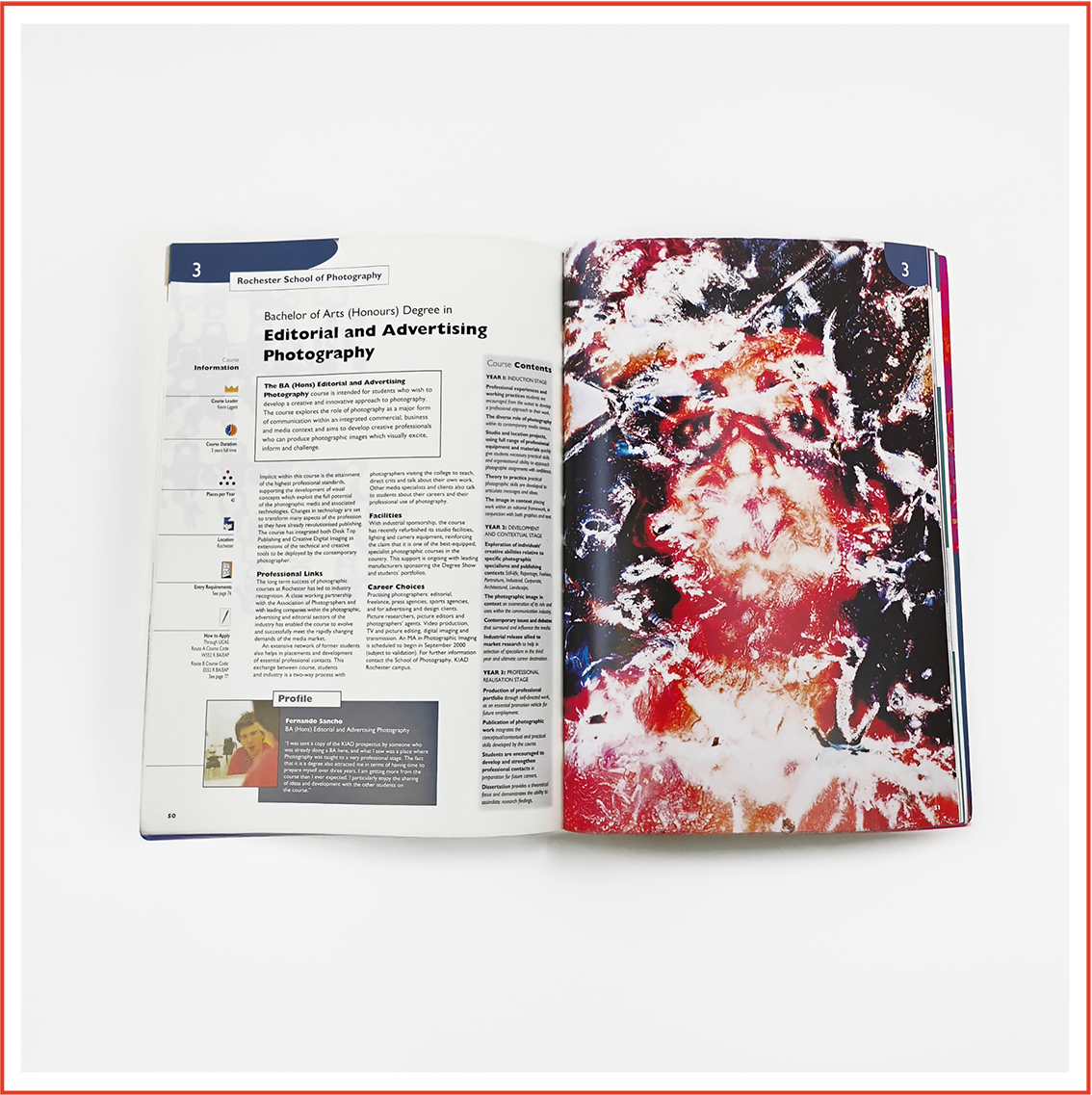
The prospectus pages for Bachelor of Arts (Honours) in Editorial and Advertising Photography | 1997
Kevin Liggett was appointed as a full-time lecturer on the three-year Diploma in Professional Photography at Medway College of Design in 1974. Over the following three decades, he undertook a wide range of teaching, academic leadership and management responsibilities within the department.
In 1995, he became Course Leader, playing a significant role in the development and expansion of photographic education at what was by then the Kent Institute of Art and Design. Following the successful introduction of the Bachelor of Arts (Honours) in Editorial and Advertising Photography and the growing international reputation of the department, he was appointed Head of School for the newly established Rochester School of Photography in 1999.
After the incorporation of KIAD into the University for the Creative Arts, Kevin was appointed Dean of Fashion, Design, Media and Culture in 2008.
Throughout his career, Kevin made a substantial contribution to photographic education and the development of creative arts programmes, both nationally and internationally.
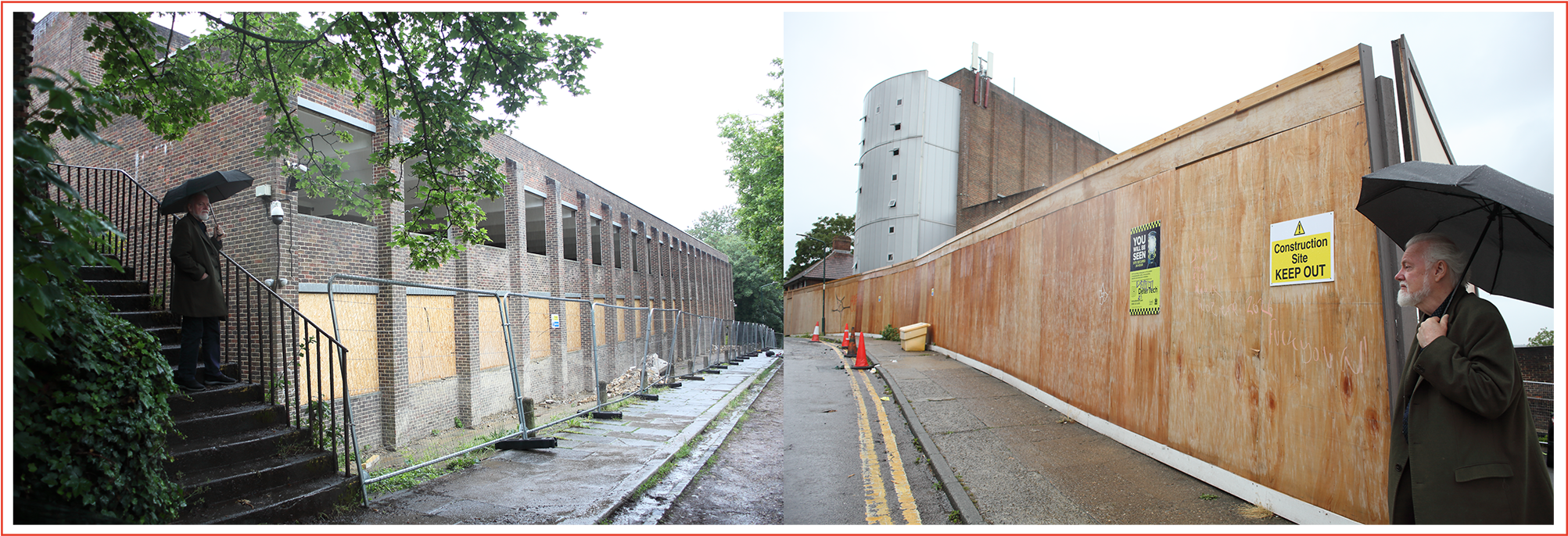
Kevin Liggett at the site of the former Kent Institute of Art Design (University for the Creative Arts) | June 2026 | Photograph by Yvonne Liggett